Arsenic and Uranium in Canyon County Water: Which Filters Actually Help
Search for Nampa water online and you will find alarming sales pages about arsenic and uranium. The actual picture is calmer and more useful. Arsenic and uranium occur naturally in southern Idaho groundwater, the City of Nampa's water meets federal and state standards, and private wells are a separate story that owners have to check themselves.
This guide explains what the city reports, how private wells differ, and which filter types are certified to reduce these contaminants if you decide to go further. It does not make health claims. Health questions belong with your doctor or the health district.
Dealing with a plumbing problem right now? Call (208) 679-8357, answered 24/7.
What Nampa's Water Reports Say
The City of Nampa's annual water quality reports state that the system has met EPA and state drinking water standards. The reports also carry a standard note that the water contains low levels of arsenic, below the EPA standard, and that EPA continues to study the health effects of low-level arsenic.
The same reports note that nitrate above 10 parts per million is a health risk for infants under six months, and that lead, when found, typically comes from service lines and home plumbing rather than the source water. They advise running the tap for 30 seconds to 2 minutes after water has sat for several hours.
In short: city water meets standards, and filtration is a personal choice to reduce specific things further, not a response to a violation.
Federal Limits for the Contaminants People Ask About
EPA sets enforceable maximum contaminant levels for public water systems. Private wells are not regulated this way, but owners often use the same numbers as a benchmark.
| Contaminant | EPA maximum contaminant level | Where it comes from here |
|---|---|---|
| Arsenic | 10 parts per billion | Naturally occurring in regional rock and groundwater |
| Uranium | 30 micrograms per liter | Naturally occurring in some aquifer rock |
| Nitrate (as nitrogen) | 10 parts per million | Fertilizer, septic systems, agriculture |
| Lead | Action level 15 parts per billion, set to drop to 10 under EPA's 2024 lead rule | Old service lines and home plumbing, not the aquifer |
Need a Plumber Now?
The 24/7 line covers emergencies and planned work across Nampa.
Private Wells Are Where Testing Matters Most
Nobody tests a private well for you. Canyon County has a lot of acreage on wells, and results can differ well to well even on neighboring parcels. Uranium made local news when the Idaho Department of Health and Welfare reviewed well water at a state facility in Nampa after tests showed high readings in one building's supply.
Agricultural areas add nitrate to the list. Near Star, for example, Idaho DEQ has designated a Northeast Star Nitrate Priority Area and invited private well owners to sampling events.
A certified lab test for arsenic, uranium, nitrate, hardness and bacteria is the right first step. Treatment should be chosen from results, not guesses.
Which Filters Are Certified to Reduce What
Look for certification to the relevant NSF/ANSI standard for the specific contaminant. A filter certified for chlorine taste is not automatically certified for arsenic.
| Technology | Arsenic | Uranium | Nitrate | Typical setup |
|---|---|---|---|---|
| Carbon block | Generally no | Generally no | No | Under sink or whole house, for taste and odor |
| Reverse osmosis (NSF/ANSI 58) | Certified models, yes | Often effective | Certified models, yes | Under sink, one faucet |
| Adsorptive media for arsenic | Yes, when sized for it | No | No | Point of use or whole house |
| Anion exchange | Some forms | Yes, in some systems | Yes, in some systems | Whole house, needs care in design |
| Water softener | No | Limited | No | Whole house, for hardness only |
Arsenic occurs in two chemical forms, and some treatments handle one far better than the other. That is one more reason to pick equipment from a lab report and a certification listing rather than a sales claim.
What to Do Before You Spend Money on Filtration
- Read the latest city report. If you are on city water, it lists detected contaminants and levels.
- Test a private well at a certified lab. Include arsenic, uranium, nitrate, hardness and bacteria.
- Match the filter to the result. Choose a system certified to reduce the specific contaminant you found.
- Plan for maintenance. Filters and membranes lose effectiveness if cartridges are not changed on schedule.
- Retest after installation. A follow-up test confirms the system is doing its job.
Getting It Installed
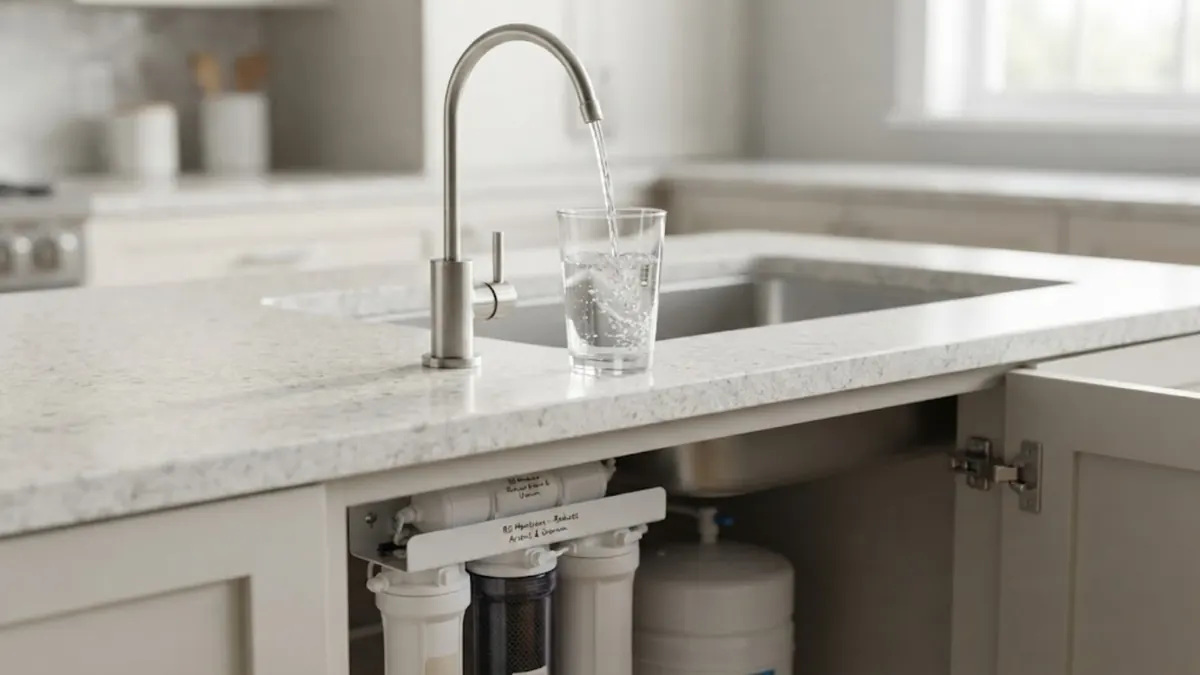
For most city-water households wanting drinking water reduction, an under-sink reverse osmosis unit at the kitchen faucet is the practical choice. On private wells with multiple issues, a staged system may be needed, sometimes with softening ahead of the RO membrane to protect it from scale.
Our water filtration installation page covers system types and upkeep, and our softener page covers the hardness side. Rural owners around Melba and similar acreage should start with the well test.
How to Read a Private Well Test
Lab reports list each tested contaminant, the amount found and usually the federal limit for comparison. Pay attention to the units, because arsenic and uranium are reported in very small units such as parts per billion or micrograms per liter, while nitrate is reported in parts per million.
A result marked non-detect means the lab found nothing above its detection limit. A result close to a federal limit is worth retesting, since levels in wells can shift with season and pumping.
Keep the report with your home records. It helps when choosing equipment, and it is useful to a future buyer who will ask about the well.
The Ongoing Cost of Keeping a Filter Honest
The purchase price is only part of the cost of filtration. Reverse osmosis units need pre-filters changed roughly every six to twelve months and membranes every few years, depending on water quality and use. Arsenic adsorptive media is replaced when it reaches its rated capacity, which a follow-up test can confirm.
Skipped maintenance is the most common reason a filter stops working. A spent cartridge does not announce itself, and the water may taste exactly the same.
Put replacement dates on a calendar the day the system is installed, keep a spare set of cartridges on hand, and retest the treated water every year or two. That turns a one-time purchase into a system you can actually rely on.
Common Questions
No. Boiling does not remove either, and as water evaporates it can concentrate them. Boiling addresses bacteria, not dissolved minerals or chemicals.
Many households use it while testing or waiting for a system to be installed. For infants and specific health concerns, ask your health care provider what they recommend.
Commonly once a year for bacteria and nitrate, and every few years for other contaminants, plus any time taste, smell or color changes.
Sometimes a single reverse osmosis unit covers the drinking tap, but wells with several issues may need staged treatment. Base the design on the lab results.