Is Nampa Water Hard Enough to Need a Water Softener?
Ask five Nampa neighbors whether their water is hard and you may get five different answers. They could all be right. The City of Nampa draws its drinking water from groundwater wells, and according to the city's water quality reports, hardness runs anywhere from none to about 7 grains per gallon depending on the well.
That spread is the whole story. A softener that makes sense on one side of town may be a waste of money on another. This guide explains what the numbers mean, how to find your own, and how to decide.
Dealing with a plumbing problem right now? Call (208) 679-8357, answered 24/7.
What Grains per Gallon Actually Means
Hardness measures dissolved calcium and magnesium. The Water Quality Association uses these bands, and one grain per gallon equals about 17.1 parts per million.
| Grains per gallon | Parts per million | Classification |
|---|---|---|
| 0 to 3.5 | 0 to about 60 | Soft |
| 3.5 to 7.0 | About 60 to 120 | Moderately hard |
| 7.0 to 10.5 | About 120 to 180 | Hard |
| Over 10.5 | Over about 180 | Very hard |
Nampa's reported range, none to 7.08 grains, spans the soft and moderately hard bands and just touches hard. Private wells outside the city can run well beyond that.
One City, Many Wells
Nampa's drinking water system draws from multiple municipal wells tapping the Snake River Plain aquifer. Water picks up minerals as it moves through rock and soil, and wells drawing from different depths or locations pick up different amounts.
Which well supplies your home depends on where you live in the distribution system, and it can change with demand. That is why the city reports a range rather than a single number, and why your neighbor's test tells you less than your own.
Need a Plumber Now?
The 24/7 line covers emergencies and planned work across Nampa.
What to Do to Find Your Own Hardness
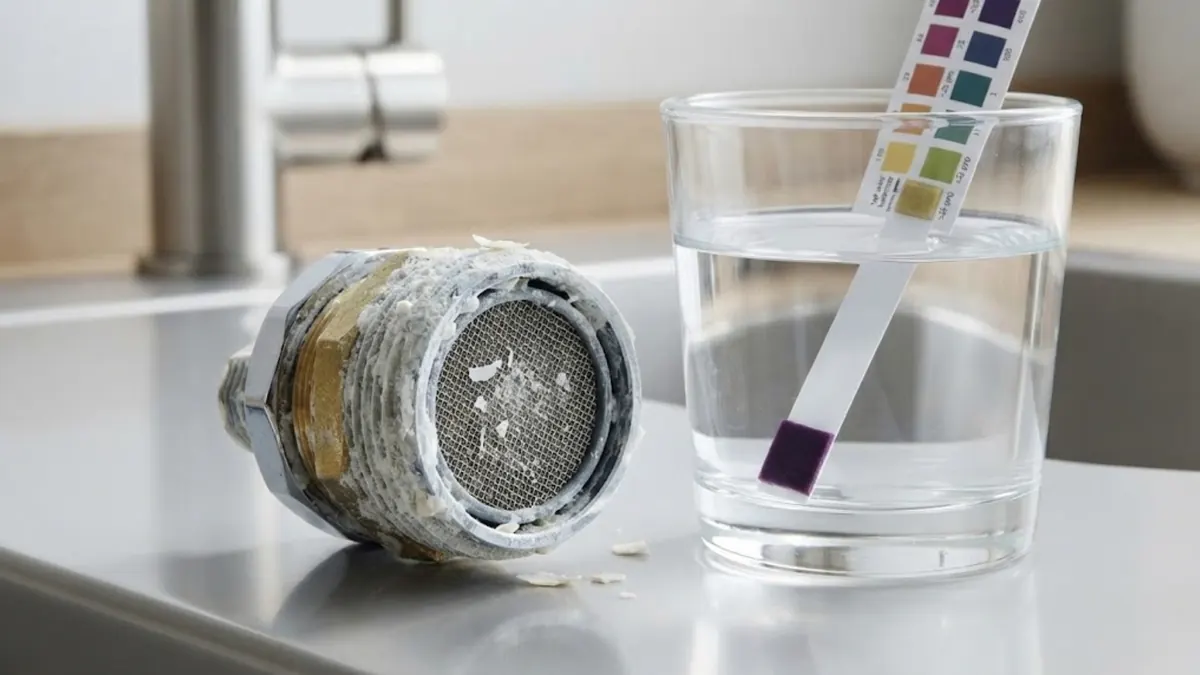
- Use a test strip. Inexpensive hardness strips from hardware stores give a quick reading at the kitchen tap.
- Check twice. Test on two different days. If the number moves, your home may be fed from more than one well at different times.
- Read the signs. White crust on faucet aerators, spots on dishes and a popping water heater all point to hardness toward the top of the range.
- Ask for a professional test before buying. A plumber or water treatment installer can test hardness, iron and pH together, which matters for sizing.
- Private well? Send a sample to a lab. Wells can differ sharply from city water and may carry iron.
When a Softener Pays Off in Nampa
Below about 3.5 grains, a softener rarely earns its keep. You may see a little spotting, but appliances will not suffer much.
Between 3.5 and 7 grains, the case depends on what you own. Scale builds on the bottom of tank water heaters and inside tankless heat exchangers, shortening their lives and wasting energy. Faucet cartridges and shower valves stick sooner. If you have a tankless unit, a new water heater or expensive fixtures, it is worth pricing a softener sized for your water.
At the top of the range, or on a private well above 7 grains, a softener usually pays for itself in longer equipment life and less descaling.
Softener, Conditioner or Nothing
Three reasonable choices, each with trade-offs.
| Option | What it does | Best for |
|---|---|---|
| Salt-based softener | Removes hardness through ion exchange | Moderately hard water, tankless heaters |
| Salt-free conditioner | Changes how minerals form scale, does not remove them | Owners wanting no salt or drain |
| No treatment | Nothing, rely on flushing and descaling | Soft water under about 3.5 grains |
If You Skip the Softener
Soft-to-moderate water can be managed without treatment. Flush the tank water heater once a year, check its anode rod every few years, soak faucet aerators in vinegar when flow drops, and descale a tankless unit on schedule.
Those habits protect a heater whether or not you soften. When a scaled tank finally quits anyway, the water heater replacement decision is a good moment to reconsider treatment.
Hardness Beyond Nampa City Limits
Neighboring cities run their own wells with their own results, and rural properties on private wells vary most of all. Around Caldwell, rural wells can carry iron alongside hardness, which calls for iron treatment ahead of any softener.
The rule is the same everywhere: test your own water, then decide.
How a Softener Is Sized for Nampa Water
A softener's capacity is rated in grains it can remove before regenerating. Sizing multiplies your hardness in grains per gallon by your household's daily water use, then by the number of days you want between regenerations.
For example, a family using 300 gallons a day at 6 grains per gallon needs about 1,800 grains of capacity per day. A unit that regenerates every week needs roughly 12,600 grains of usable capacity, and sizing usually adds a margin on top of that.
Nampa's moderate hardness means many homes need a smaller unit than a very hard water area would. Oversizing wastes money and can leave resin sitting idle too long. That is why testing comes before buying.
What Hard Water Looks Like Day to Day
Before any test, the house usually gives hints. White crust forms on faucet aerators and showerheads. Glassware comes out of the dishwasher cloudy or spotted. Soap does not lather well, and a film lingers on shower doors.
Behind the walls, the effects are slower and more costly. Scale collects inside the water heater, in the heat exchanger of a tankless unit and in the cartridges of faucets and shower valves.
If you see several of these signs, your home is probably toward the upper end of Nampa's range, and a test will confirm it.
Common Questions
No. The city draws groundwater from its wells and reports the natural hardness range. It also notes that it does not add fluoride, so any fluoride present is naturally occurring.
Small amounts, sometimes, but iron can foul softener resin. Private wells with noticeable iron usually need iron treatment ahead of the softener.
It depends on hardness, water use and the unit's efficiency. Metered, demand-based units use less than older timer-based models because they regenerate only when needed.
Yes, for a quick estimate. For sizing equipment, a more precise test is worth having done, ideally including iron and pH.
Hard water is mainly a household nuisance. The City of Nampa's reports note that hardness can leave residue on fixtures but does not pose a public health hazard. The reasons to soften are appliance life and cleaning, not health.