Tankless vs. Tank Water Heaters for Treasure Valley Homes
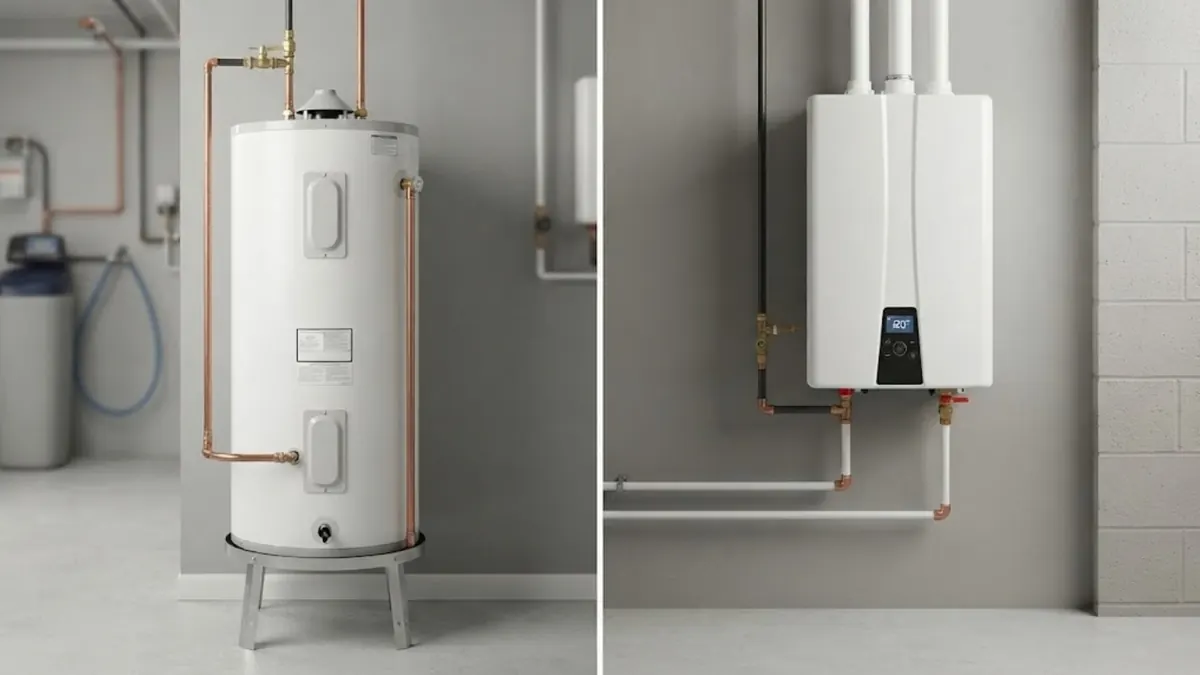
When a tank water heater dies, the tankless question comes up almost every time. Tankless units never run out of hot water and take up less space. They also cost more to install and need more attention on hard water.
Neither choice is right for every house. This guide compares the two for Treasure Valley conditions specifically: cold winter groundwater, a range of water hardness, and local gas and electric utilities.
Dealing with a plumbing problem right now? Call (208) 679-8357, answered 24/7.
Tank and Tankless Compared
A straight comparison of the factors that matter most for a typical Nampa-area home.
| Factor | Tank (gas) | Tankless (gas) |
|---|---|---|
| Upfront installed cost | Lower | Higher, often much higher on conversions |
| Hot water supply | Limited to tank size, then recovery time | Continuous, limited by flow rate |
| Operating cost | Moderate, heats water all day | Lower, heats only on demand |
| Space | Floor space for the tank | Wall mounted, frees floor space |
| Typical life | Around 8 to 12 years | Often longer with regular descaling |
| Hard water upkeep | Annual flush helps | Descaling needed, usually yearly on harder water |
| Power outage | Gas tanks often keep working | Needs electricity to fire |
Why Tankless Units Feel Weaker in January
A tankless heater is rated by how many gallons per minute it can heat by a given number of degrees. In winter, groundwater reaches the house colder, so the unit has to add more heat to every gallon, and the flow it can deliver at full temperature drops.
That is why a correctly sized unit in July can struggle to run two showers in January. Sizing for winter incoming water, not summer, avoids disappointment.
Tank heaters handle winter differently. They store hot water, so a cold morning shows up as a longer recovery time rather than lukewarm water mid-shower.
Need a Plumber Now?
The 24/7 line covers emergencies and planned work across Nampa.
Scale Is the Deciding Factor for Many Nampa Homes
Nampa's city wells range from soft to about 7 grains per gallon. Tankless heat exchangers have narrow passages that scale can choke quickly, which triggers error codes and reduces output.
On softer water, a yearly descale keeps a tankless unit healthy. On harder water, pairing tankless with a water softener is often the difference between a long-lived unit and a frustrating one. Our tankless maintenance page describes what descaling involves.
A tank heater tolerates scale better but still loses efficiency and life to it.
What Switching From Tank to Tankless Involves
A like-for-like tank swap is simple. Converting to tankless changes several parts of the installation.
| Item | Why it changes | Effect |
|---|---|---|
| Gas supply line | Tankless units draw far more gas at full fire | Often needs a larger line |
| Venting | Condensing units vent through PVC | New vent run, condensate drain |
| Electrical | Controls and freeze protection need power | Outlet near the unit |
| Location | Wall mounting | Frees floor space, may shorten piping runs |
Rebates and Incentives in 2026
Intermountain Gas has offered rebates on tankless water heaters rated 0.91 UEF or higher. Idaho Power runs an incentive for heat pump water heaters installed in existing homes, which is a third option worth considering if you have garage space. The federal 25C tax credit for these upgrades ended on December 31, 2025, so utility programs are the main incentives left.
Program terms change, so confirm current eligibility before choosing a model.
What to Do to Make the Right Choice
- Count your peak demand. How many showers and appliances run at once on a winter morning?
- Test your hardness. Above about 3.5 grains, plan for a softener or disciplined descaling with tankless.
- Get a conversion quote, not just a unit price. Gas line, venting and electrical often cost more than the heater.
- Think about how long you will stay. Tankless savings accumulate slowly. A short stay favors a tank.
- Compare three options. Tank, tankless and heat pump each suit different houses. Our water heater replacement page lays them out.
Which One Fits Your House
Choose tankless if you regularly run out of hot water, want wall space back, plan to stay for years and can keep up with descaling or soften your water. Choose a tank if budget matters most, the old tank met your needs, or you want the simplest possible swap.
In newer communities such as Star, where most homes are young, the more common question is how to maintain the heater you already have rather than whether to switch.
Where Heat Pump Water Heaters Fit
A heat pump water heater is a tank that heats water by moving heat from the surrounding air instead of generating it directly. It is the most efficient electric option, and Idaho Power offers an incentive for installing one in an existing home.
It needs space around it for airflow and works best in a garage or large utility room. In winter, garages get cold and the unit leans on its backup electric element, which reduces its savings in January but not in the rest of the year.
For homes without natural gas, or owners wanting to move off gas, it is worth pricing alongside a standard electric tank.
How Big a Tankless Unit Does a Nampa Home Need
Tankless sizing starts with peak demand. Add up the flow of the fixtures that realistically run at the same time on a winter morning, for example two showers and a kitchen faucet.
Then consider the temperature rise, which is the difference between incoming groundwater and your target hot water temperature. Winter groundwater is colder, so the rise is larger, and a unit's rated flow drops as the rise increases.
A unit sized from summer conditions or from a single shower will disappoint a busy household in January. It is better to size for the coldest realistic month and the busiest realistic hour.
Common Questions
It lowers operating cost by heating only on demand, but the higher installation cost takes years to recover. The savings are real, the payback is slow.
It does not run out, but it can fall short on temperature if demand exceeds its flow rating, especially in winter.
Yes, even gas models need power for controls and ignition. During a power outage they stop working.
Most manufacturers recommend at least yearly, and more often on harder water unless it is softened.
Often near it, since the water and gas lines are already there. The unit mounts on the wall, and the gas line, venting and power are the parts that usually change.